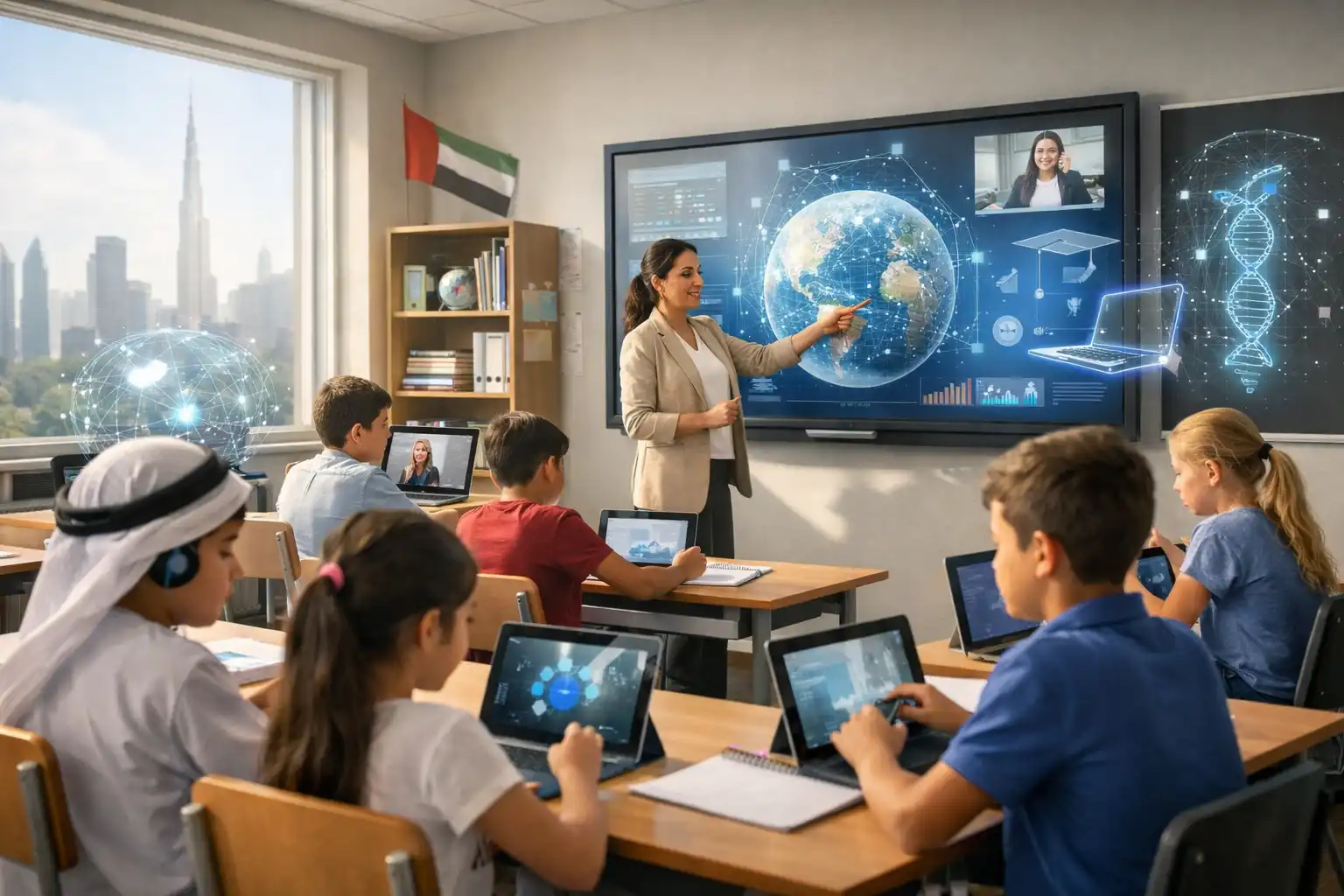
Skill-Based Learning in UAE: A Growing Trend
Skill-based learning in UAE is becoming an increasingly important part of the country’s education and workforce-development landscape. Instead of focusing only on traditional academic knowledge, skill-based education emphasizes practical abilities, critical thinking, communication, creativity, collaboration, digital literacy, problem-solving, and specialized technical capabilities.
This approach is closely aligned with the UAE’s focus on future-ready education and lifelong learning. The UAE Advanced Skills Strategy identifies four broad categories of future skills: basic skills, competencies, personality traits, and specialized skills. It also targets school and university students, new graduates, and experienced employees. The UAE Government’s Advanced Skills Strategy positions lifelong learning and adaptable skills as important parts of human-capital development.
The Ministry of Education’s current strategy similarly aims to align education outcomes with future skills while encouraging technology and innovation in education. The Ministry of Education strategy identifies future skills, advanced technology, innovation, and lifelong learning among its key priorities.
As technology and employment requirements continue to evolve, skill-based learning can help students and professionals build capabilities that can be applied across different careers and industries.
What Is Skill-Based Learning?
Skill-based learning is an educational approach that focuses on what learners can actually do with the knowledge they acquire. Instead of measuring progress only through memorization or traditional examinations, it can include practical projects, problem-solving activities, presentations, simulations, collaborative work, assessments, and real-world applications.
The goal is not to replace academic knowledge. Knowledge remains important, but learners are also encouraged to develop the skills required to apply that knowledge effectively.
For example, a student studying business may learn accounting concepts while also developing communication, presentation, financial-analysis, teamwork, and digital skills. A technology student may combine theoretical concepts with programming projects, data analysis, cybersecurity exercises, or artificial intelligence applications.
This practical orientation makes skill-based learning relevant to schools, universities, vocational institutions, professional training providers, and online education platforms.
Why Skill-Based Learning Is Growing in the UAE
1. Changing Workforce Requirements
Employers increasingly need people who can combine technical knowledge with practical and interpersonal abilities. Digital transformation, automation, artificial intelligence, data-driven decision-making, and new business models are changing the skills required across many sectors.
The UAE National Employment Strategy 2031 highlights skills development, lifelong learning, future-skills training, entrepreneurship, and labour-market capabilities as important elements of building a knowledge-based economy.
This creates a stronger connection between education and employment. Learners are increasingly expected to develop capabilities that can be applied in real workplace situations rather than relying only on academic qualifications.
2. Greater Focus on Future Skills
The UAE education system is placing increasing attention on capabilities that can help learners adapt to changing economic and technological conditions.
The UAE National Program for Advanced Skills includes foundational literacies in science, technology, and finance, along with competencies such as critical thinking, creativity, communication, and collaboration. It also includes character qualities such as adaptability, leadership, empathy, social and cultural awareness, and a growth mindset. The National Program for Advanced Skills provides a framework for developing these capabilities across different learner groups.
3. Technology Is Changing How People Learn
Digital technology has expanded access to practical education. Students and professionals can now use online courses, simulations, collaborative platforms, digital assessments, coding environments, educational applications, and other tools to develop skills outside traditional classrooms.
The UAE Ministry of Education has also been increasing its focus on digital innovation. In 2025, the Ministry highlighted a skill-driven future and digital education innovation, including the introduction of artificial intelligence as a formal subject across public-school grade levels.
These developments show how digital literacy and technology-related capabilities are becoming increasingly connected to education.
4. Lifelong Learning Is Becoming More Important
Skill development is no longer limited to school and university years. Professionals may need to learn new technologies, management approaches, digital tools, or industry-specific capabilities throughout their careers.
The UAE Advanced Skills Strategy specifically promotes lifelong learning for students, graduates, and experienced employees. This creates opportunities for universities, training providers, online learning platforms, and employers to support continuous skill development.
Readers can explore private education and online learning in the UAE for a broader view of how traditional and digital education models are developing.
Key Skills Encouraged Through Skill-Based Learning
Critical Thinking
Critical thinking helps learners evaluate information, identify assumptions, compare alternatives, and make reasoned decisions. It is useful across education, business, technology, healthcare, finance, and many other sectors.
Communication
Communication skills include writing, speaking, presentation, listening, and the ability to explain complex information clearly. Strong communication can improve collaboration and professional performance.
Problem-Solving
Problem-solving involves identifying challenges, analyzing possible causes, evaluating solutions, and implementing appropriate responses. Practical assignments and project-based learning can provide opportunities to develop this capability.
Creativity
Creative thinking helps learners develop new ideas, explore alternatives, and approach challenges from different perspectives. It is relevant not only to artistic subjects but also to business, engineering, technology, marketing, and entrepreneurship.
Collaboration
Many modern workplaces depend on teams. Group projects, collaborative assignments, presentations, and practical activities can help students learn how to communicate responsibilities, resolve differences, and work toward shared objectives.
Digital Literacy
Digital literacy includes the ability to use technology effectively, evaluate online information, work with digital tools, communicate through technology, and understand basic digital-security practices.
Financial Literacy
Understanding budgeting, saving, financial planning, and basic economic concepts can help learners make more informed personal and professional decisions.
Adaptability
Adaptability is increasingly important when technologies, job roles, and business processes change. Learners who can acquire new skills and adjust to unfamiliar situations may be better prepared for evolving career requirements.
Leadership
Leadership skills can involve decision-making, responsibility, communication, collaboration, conflict management, and the ability to support others. These capabilities can be developed through projects, student organizations, volunteering, and workplace experiences.
Skill-Based Learning in UAE Schools
Schools can incorporate skill development into traditional subjects rather than treating practical skills as completely separate from academic education.
Project-based assignments, presentations, laboratory work, coding activities, research projects, debates, teamwork, entrepreneurship exercises, and community initiatives can all give students opportunities to apply knowledge.
Dubai parents evaluating schools can also consider how individual schools approach practical learning, technology, extracurricular activities, and future skills. The guide to choosing the right school in Dubai provides a related framework for comparing educational options.
Private education is also an important part of this development. Families can compare curricula and educational approaches through the wider private-school sector, where schools may use different methods for developing academic and practical capabilities.
Skill-Based Learning in Universities and Higher Education
Universities play an important role in connecting academic study with professional capabilities. Students can benefit from internships, research projects, industry collaborations, practical laboratories, entrepreneurship programs, competitions, and career-development activities.
Higher education can also provide opportunities for students to develop specialized technical skills alongside broader capabilities such as communication, teamwork, research, and analytical thinking.
The UAE’s higher-education direction has long emphasized innovation, professional learning, research, and skills that support the needs of the knowledge economy.
Students comparing higher-education pathways can also explore the guide to top universities in the UAE.
The Role of Vocational and Technical Education
Skill-based education also creates opportunities for vocational and technical learning. These pathways can provide practical preparation for specific occupations and industries.
Depending on the field, vocational education can include technical maintenance, engineering support, hospitality, healthcare assistance, information technology, manufacturing, construction, automotive services, and other applied areas.
Technical training can be particularly valuable when it combines classroom knowledge with supervised practical experience and recognized qualifications.
Online Learning and Skill Development
Online learning has made skill development more accessible to students, professionals, and lifelong learners. A learner can study programming, digital marketing, project management, languages, data analysis, design, business, or other subjects without necessarily attending a traditional classroom.
Online platforms can also support flexible learning schedules, making them useful for professionals who want to develop skills while continuing to work.
Those exploring digital education can review online learning platforms in the UAE, online courses in the UAE, and e-learning websites in the UAE.
Benefits of Online Skill Development
- Flexible study schedules.
- Access to specialized courses.
- Self-paced learning opportunities.
- Ability to revisit lessons and resources.
- Access to international instructors and content.
- Opportunities to learn new digital tools.
- Convenient professional development.
However, learners should evaluate course quality, instructor expertise, assessment methods, practical projects, certification, and recognition before selecting an online program.
The broader benefits of online learning in the UAE can help learners understand where digital education is most useful.
How Employers Benefit From Skill-Based Learning
Skill-based learning can also benefit employers by helping them identify and develop capabilities that are directly relevant to their operations.
Better Workforce Readiness
Employees with practical skills may require less time to adapt to certain tasks, particularly when training reflects real workplace situations.
Continuous Upskilling
Organizations can provide employees with training programs that develop new technical and interpersonal skills as business requirements change.
Improved Internal Mobility
Employees who develop transferable skills may be able to move into new responsibilities or roles as organizations grow.
Adaptation to Technology
Technology adoption often requires employees to learn new systems and workflows. Continuous training can make digital transformation easier to implement.
This is particularly relevant as UAE businesses increasingly adopt digital systems, artificial intelligence, analytics, and automation.
Skill-Based Learning and Artificial Intelligence
Artificial intelligence is changing both the workplace and education. As AI tools become more widely used, learners need to understand not only how to operate AI systems but also how to evaluate their outputs, identify limitations, use information responsibly, and apply human judgment.
In June 2026, the UAE Ministry of Education introduced the NOVA project to advance AI-driven institutional transformation and use data and technology to support educational decision-making and outcomes.
The Ministry and Hamdan Bin Mohammed Smart University also launched a National AI Upskilling Programme for teachers in May 2026. The program is designed to help teachers use AI technologies effectively and confidently in classroom environments.
These developments indicate that AI-related capabilities are becoming part of broader professional and educational skill development.
Readers interested in the wider technology environment can also explore artificial intelligence and intelligent agents, digital transformation in the UAE, and AI in UAE business.
How Parents Can Encourage Skill Development
Parents can support skill-based learning by encouraging children to participate in activities that require practical application, creativity, communication, and problem-solving.
- Encourage children to complete practical projects.
- Support reading and independent research.
- Introduce age-appropriate technology and coding activities.
- Encourage sports and teamwork.
- Allow children to explore creative interests.
- Teach basic financial concepts.
- Encourage presentations and public speaking.
- Discuss real-world problems and possible solutions.
- Support responsible online learning.
The goal is not to overload children with additional courses. Instead, parents can create opportunities for children to apply what they already learn in school.
How Students Can Build a Skill-Based Learning Plan
Students can make skill development more effective by identifying the capabilities they need for their intended academic or career direction.
Step 1: Identify Your Career Interests
Start by identifying industries, professions, or academic subjects that interest you. This makes it easier to determine which technical and transferable skills are relevant.
Step 2: Assess Your Current Skills
Review your strengths and identify areas where improvement is needed. The UAE National Program for Advanced Skills includes the Future Fit self-assessment tool to help individuals explore their strengths and areas for development.
Step 3: Select Relevant Learning Resources
Choose courses, projects, workshops, internships, competitions, or other experiences that directly support the skills you want to develop.
Step 4: Practice Through Real Projects
Practical application is important. Students can create portfolios, complete projects, participate in competitions, volunteer, or work on independent assignments that demonstrate their abilities.
Step 5: Review Progress Regularly
Skill development is an ongoing process. Review your progress and update your learning plan as your academic and career goals become clearer.
Challenges of Skill-Based Learning
Measuring Practical Skills
Some skills are more difficult to measure than traditional academic knowledge. Communication, creativity, leadership, teamwork, and problem-solving may require practical assessments and observation.
Teacher Training
Effective skill-based education requires teachers to design meaningful activities, assess practical outcomes, use technology appropriately, and provide useful feedback.
Keeping Education Relevant
Technology and workplace requirements change quickly. Education providers need to review curricula and training programs regularly to ensure that learners develop relevant capabilities.
Access to Practical Opportunities
Not every learner has equal access to laboratories, internships, advanced technology, specialist equipment, or extracurricular activities. Education providers need to consider accessibility when developing practical learning models.
Avoiding Overemphasis on Short-Term Skills
Skill-based learning should not focus only on immediately marketable abilities. Strong foundational knowledge, critical thinking, adaptability, communication, and lifelong-learning habits remain valuable because they allow people to acquire new skills later.
The Future of Skill-Based Learning in UAE
The UAE’s education direction increasingly connects learning outcomes with future skills, technology, innovation, and workforce requirements. In 2026, the National Education Charter further emphasized future skills including critical thinking, effective communication, AI mastery, literacy, creativity, numeracy, and financial literacy.
This suggests that skill development will increasingly be integrated into mainstream education rather than treated as a separate training activity.
AI, data analysis, digital literacy, communication, creativity, problem-solving, collaboration, adaptability, and specialized technical skills are likely to remain important areas of development.
At the same time, traditional academic knowledge will continue to matter. The strongest approach is likely to combine strong foundations with practical application and continuous skills development.
Readers can explore the broader future of education in the UAE to understand how these changes fit into the country’s wider education landscape.
Frequently Asked Questions
What is skill-based learning in UAE?
Skill-based learning focuses on developing practical and transferable abilities alongside academic knowledge. These can include communication, critical thinking, creativity, collaboration, digital literacy, problem-solving, adaptability, and specialized technical skills.
Why is skill-based learning important?
It can help learners apply knowledge in practical situations and prepare for changing academic, professional, and technological requirements.
What are future skills in the UAE?
The UAE’s skills frameworks include foundational literacies, competencies such as critical thinking and communication, character qualities such as adaptability and leadership, and specialized technical skills.
Can online courses support skill-based learning?
Yes. Online courses can provide flexible access to technical and professional subjects, especially when they include practical assignments, projects, assessments, and opportunities to apply what has been learned.
How can schools develop practical skills?
Schools can use project-based learning, group activities, presentations, research, coding, laboratory work, entrepreneurship activities, competitions, and community projects to help students apply academic knowledge.
Is AI becoming part of skill-based education in UAE?
Yes. AI is increasingly incorporated into the UAE’s education and professional-development agenda. Recent Ministry of Education initiatives include AI-focused educational transformation and teacher upskilling.
Conclusion
Skill-based learning in UAE is becoming an important part of the country’s approach to education, workforce development, and lifelong learning. The emphasis is increasingly moving beyond what learners know toward what they can apply, create, communicate, and solve.
Students can benefit by developing practical capabilities alongside academic knowledge, while professionals can use continuous learning to adapt to changing technologies and career requirements.
With the UAE continuing to emphasize future skills, digital transformation, AI, innovation, and lifelong learning, skill-based education is likely to become an increasingly important part of the country’s education ecosystem.