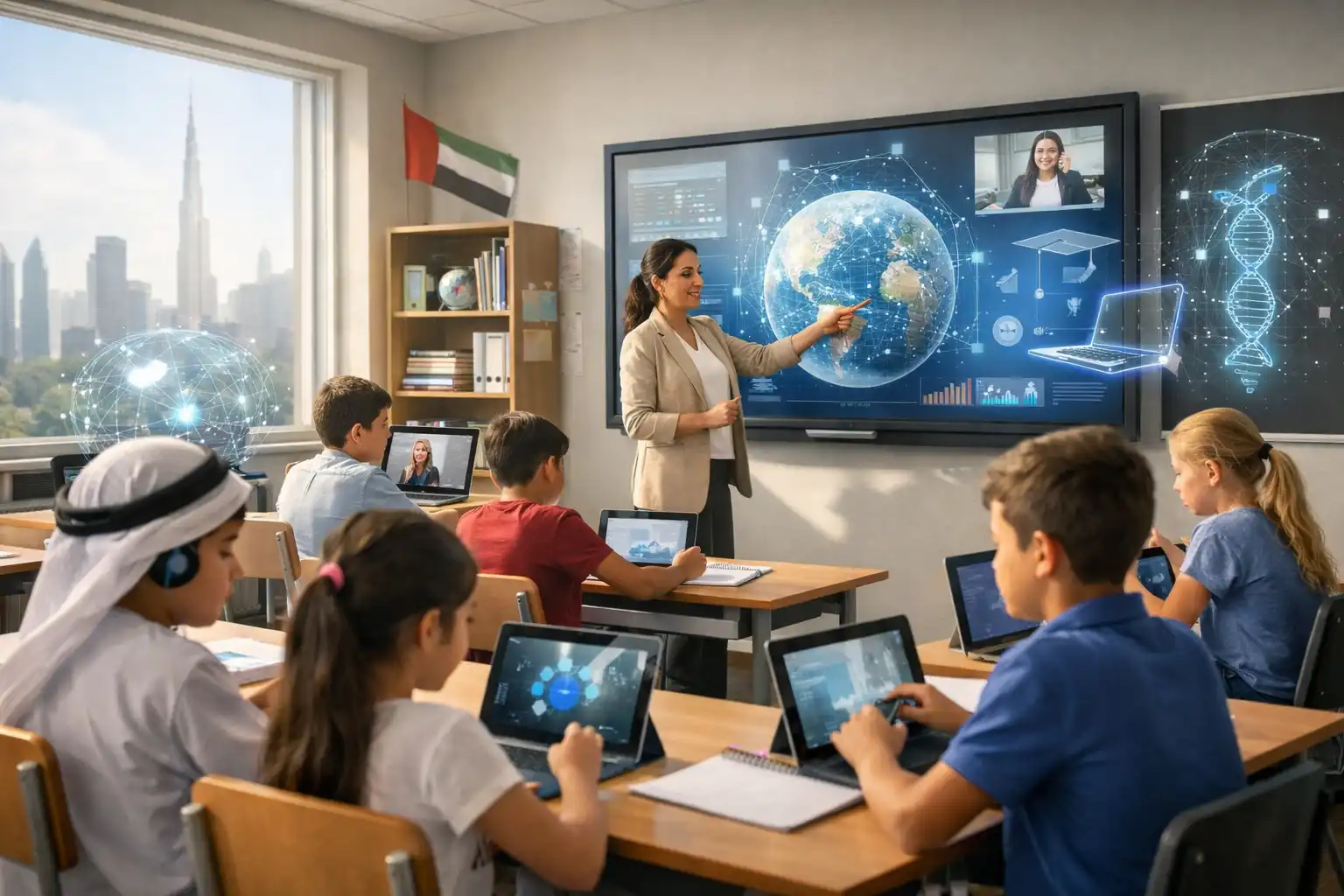
What Is Changing in UAE Education?
Education is moving beyond a model based mainly on classroom instruction and traditional examinations. Digital platforms, practical projects, data-driven assessment, artificial intelligence, online resources, and personalized learning are creating additional ways for students to develop knowledge and skills.
This does not mean traditional schools and universities are becoming irrelevant. Instead, physical education and digital education are increasingly being combined. Students can learn in classrooms, complete digital assignments at home, participate in online lessons, use educational applications, and access resources beyond their school’s physical facilities.
This broader transformation is also connected to the growth of private education and online learning in the UAE.
1. Artificial Intelligence Will Have a Larger Role in Education
Artificial intelligence is one of the most significant technologies influencing the future of education. AI can support teachers, administrators, students, and institutions in areas such as learning analytics, content creation, assessment, personalization, administrative processes, and educational support.
In June 2026, the UAE Ministry of Education launched the NOVA project to advance comprehensive institutional transformation powered by AI. The project uses data and modern technologies to improve decision-making, institutional efficiency, educational outcomes, and services for students, teachers, schools, and parents. The Ministry’s NOVA announcement describes AI-driven transformation as part of a broader effort to create a more agile and future-ready education system.
AI is also becoming relevant to classroom teaching. In May 2026, the Ministry of Education and Hamdan Bin Mohammed Smart University launched a National AI Upskilling Programme for Teachers designed to help Ministry teachers use AI technologies more effectively and confidently in educational settings.
The growth of AI in education makes AI literacy increasingly important for both educators and learners. Students need to understand not only how to use AI tools but also how to evaluate their outputs, recognize limitations, protect information, and apply human judgment.
Readers can explore the broader topic of artificial intelligence and intelligent agents to understand how AI is developing across different sectors.
2. Future Skills Will Become More Important
Future education will increasingly focus on what students can do with knowledge rather than only what they can remember. Skills such as critical thinking, communication, creativity, problem-solving, collaboration, adaptability, digital literacy, and financial literacy are becoming more important.
The UAE National Education Charter announced in 2026 identifies critical thinking, effective communication, AI mastery, literacy, creativity, numeracy, and financial literacy among its future-skills priorities. The framework also emphasizes self-management, teamwork, wellbeing, cultural awareness, and lifelong learning.
This direction connects directly with the growth of skill-based learning in the UAE, where students develop practical and transferable capabilities alongside academic knowledge.
3. Schools Will Become More Technology-Enabled
Technology is increasingly becoming part of everyday school operations and teaching. Learning-management systems, digital assignments, interactive educational resources, online assessments, collaborative tools, tablets, laptops, and data platforms can all support learning.
However, the future of education is not simply about putting more devices into classrooms. Technology is most useful when it solves a genuine educational problem or helps teachers and students achieve better outcomes.
Schools may increasingly use technology to identify learning gaps, provide additional resources, communicate with parents, support differentiated learning, and make administrative processes more efficient.
Parents evaluating schools can also review how to choose the right school in Dubai, including factors such as curriculum, teaching quality, facilities, student support, and technology.
4. Blended Learning Will Connect Classrooms and Digital Platforms
Blended learning combines face-to-face teaching with digital education. Rather than treating online learning and classroom learning as competing models, schools and universities can use both to create a more flexible educational experience.
A student might attend a classroom lesson, watch an instructional video later, complete an online activity, participate in a virtual discussion, and then return to school for a practical project.
This model can also provide flexibility when students need additional time with a topic. Digital resources can be revisited, while teachers remain available to provide guidance and clarification.
The UAE already has a growing ecosystem of digital education resources. The UAE Government highlights online training and digital-learning initiatives as part of the country’s education services.
Readers can explore e-learning trends in the UAE for a closer look at how digital education is developing.
5. Online Learning Will Support Lifelong Education
Education is increasingly extending beyond school and university. Professionals need to update their skills as industries adopt new technologies, while adults may return to education to change careers or develop specialized capabilities.
Online learning makes this process more flexible because learners can access courses without necessarily attending a physical institution every day.
Online education can support areas such as programming, business, digital marketing, project management, data analysis, design, languages, professional certifications, and many other subjects.
The site’s guides to online learning platforms in the UAE, online courses in the UAE, and e-learning websites in the UAE provide additional context for learners exploring digital education.
6. Personalized Learning Will Become More Practical
Students do not all learn in the same way or at the same speed. Technology can help schools and universities identify learning patterns and provide additional resources based on individual needs.
Personalized learning may involve adaptive educational platforms, targeted practice exercises, additional explanations, customized assignments, or recommendations for further study.
Teachers remain essential to this process because data alone cannot fully explain why a student is struggling. The strongest approach combines educational technology with professional teacher judgment.
7. Teachers Will Become Even More Important
Technology is changing the role of teachers rather than eliminating the need for them. Teachers can increasingly focus on mentoring, discussion, critical thinking, project supervision, student wellbeing, and personalized support while digital tools assist with selected tasks.
The UAE’s 2026 National AI Upskilling Programme for Teachers demonstrates the importance placed on preparing educators for technology-enabled teaching. The program was designed to help teachers use AI effectively and confidently within classroom environments.
The Ministry’s wider strategy also emphasizes empowering educational staff and providing continuous support so teachers can contribute effectively to improving education outcomes.
8. Assessment Will Become More Flexible and Data-Driven
Traditional examinations will continue to have a role, but assessment can increasingly include projects, presentations, practical assignments, digital activities, continuous evaluation, and other methods of demonstrating learning.
In April 2026, the Ministry of Education adjusted the assessment mechanism for selected Group B subjects to support education continuity during distance learning. For subjects where assessment continued, assignments, projects, and teacher-led assessments were delivered through approved digital platforms.
This demonstrates how assessment systems can adapt to different learning environments while maintaining academic standards.
The future of education may therefore place greater emphasis on measuring practical understanding, application, progress, and skills rather than relying on a single high-stakes assessment.
9. Universities Will Strengthen Links With Industry
Higher education is increasingly expected to prepare students for real-world careers. Universities can support this goal through internships, research partnerships, industry projects, entrepreneurship programs, career services, applied learning, and professional development.
Students may increasingly choose universities based not only on reputation but also on employability, research opportunities, industry connections, technology infrastructure, and the relevance of their programs.
Students comparing higher-education options can explore top universities in the UAE as part of their research.
10. Practical and Skill-Based Education Will Expand
Employers need graduates who can apply knowledge to real situations. This is encouraging education providers to place greater emphasis on practical projects, teamwork, communication, research, digital skills, and problem-solving.
Skill-based learning can help students build portfolios and demonstrate capabilities that may not be fully represented by examination grades.
This approach is particularly relevant to technology, engineering, business, healthcare, media, design, finance, and other fields where practical competence is important.
The UAE’s broader education direction connects learning outcomes with future skills and workforce requirements, making the benefits of online learning and flexible skills development increasingly relevant.
11. AI Literacy Will Become a Core Educational Capability
AI literacy is likely to become as important as other forms of digital literacy. Students need to understand how AI systems work at an appropriate level, how to interact with AI tools, how to verify generated information, and how to use these technologies responsibly.
Teachers also need practical AI skills so they can evaluate educational applications, design appropriate activities, and guide students on responsible use.
The UAE Government’s AI guidance recognizes the broad impact of AI and the importance of AI literacy for people at different stages of life, including students and professionals.
AI adoption in education is therefore likely to focus on both technical capability and responsible use.
12. Education Will Become More Connected to the Labour Market
One of the most important long-term trends is closer alignment between education and employment requirements.
The National Education Charter links educational outcomes to strategic sectors and labour-market needs. This creates a stronger incentive for education providers to understand which capabilities employers will require in the future.
Students may increasingly benefit from career guidance, internships, practical projects, industry mentorship, and programs designed around real workplace skills.
This also reinforces the importance of future-focused education in the UAE as part of a broader national development strategy.
13. Universities Will Continue Expanding Digital Education
Universities can use online platforms to offer flexible courses, professional certificates, continuing education, hybrid programs, and digital resources alongside campus-based degrees.
This can help universities reach working professionals and international learners while giving existing students additional learning options.
Smart-education institutions can also play a role in developing new teaching models. Partnerships between universities and government institutions, such as the national AI teacher-upskilling initiative, demonstrate how higher education can contribute to wider education transformation.
14. Student Wellbeing Will Remain a Priority
Future education cannot focus only on technology and academic performance. Student wellbeing, resilience, communication, self-management, social development, and healthy learning environments are also important.
The National Education Charter includes self-management, discipline, teamwork, self-confidence, physical and mental wellbeing, cultural awareness, and lifelong learning among the learner attributes it seeks to strengthen.
This broader approach recognizes that successful education involves developing balanced individuals rather than measuring achievement only through academic results.
15. Education Technology Will Become More Integrated
Education technology is likely to become less visible as a separate category and more integrated into everyday educational systems.
Instead of using individual digital tools for isolated tasks, schools and universities may increasingly connect learning platforms, assessment systems, student records, communication tools, analytics, and administrative systems.
The Ministry’s NOVA project reflects this direction at the institutional level by seeking to use reliable data, smart systems, and advanced digital services to improve workflows and decision-making.
This broader digital transformation is also relevant to the UAE’s wider technology ecosystem, including digital transformation in the UAE.
16. Parents Will Have Greater Access to Education Information
Digital systems can make it easier for parents to communicate with schools and access information about attendance, assignments, academic progress, activities, announcements, and other aspects of their child’s education.
This can encourage greater collaboration between families and schools, provided that communication remains clear and does not create unnecessary administrative pressure for teachers or parents.
Parents can also use official school and education-authority information when comparing educational options rather than relying only on advertising or informal recommendations.
17. The Future of Education Will Not Be Entirely Digital
Despite rapid technological development, physical learning environments will continue to have an important role.
Classrooms provide direct interaction with teachers and peers. Laboratories provide practical experiences. Sports facilities support physical development. Group activities develop communication and teamwork. Universities provide research environments and professional networks.
The most effective future education model is therefore likely to combine digital capabilities with strong human interaction and practical experiences.
Challenges Facing the Future of Education in UAE
Digital Access and Inclusion
Technology-enabled learning depends on appropriate devices, connectivity, software, and support. Education providers need to consider accessibility so that digital transformation does not create new barriers.
Teacher Training
Teachers need continuous professional development to use new technologies effectively. Technology adoption without adequate training can create additional complexity rather than improving learning.
Data Privacy and Security
Digital education systems handle information about students, families, teachers, and institutions. Appropriate cybersecurity, privacy controls, access management, and responsible data practices are therefore essential.
Maintaining Human Connection
Excessive reliance on digital tools can reduce opportunities for face-to-face interaction. Education providers need to maintain a balance between technology and human relationships.
Keeping Curricula Current
Technology and employment requirements can change faster than traditional curriculum cycles. Education systems need mechanisms for reviewing and updating content while maintaining academic quality and consistency.
How Students Can Prepare for the Future of Education
Students can prepare by developing a combination of academic knowledge, practical skills, digital literacy, and adaptable learning habits.
- Develop strong communication skills.
- Practice critical thinking and problem-solving.
- Learn to use digital tools responsibly.
- Build basic AI literacy.
- Participate in practical projects.
- Develop teamwork and collaboration skills.
- Explore subjects connected to future career interests.
- Use online learning to supplement classroom education.
- Build portfolios that demonstrate practical abilities.
- Continue learning beyond formal qualifications.
How Parents Can Prepare for Education Changes
Parents can support their children by focusing on long-term development rather than chasing every new educational technology.
When evaluating a school or learning platform, consider the quality of teaching, curriculum, student support, practical learning, technology use, wellbeing, communication, and preparation for future skills.
Parents should also encourage children to develop curiosity and independent learning habits. These qualities can remain valuable even when specific technologies or job requirements change.
What the Future May Look Like for UAE Schools
Schools are likely to become more connected, data-informed, flexible, and technology-enabled. Classrooms may increasingly combine teacher-led instruction with digital resources, AI-supported tools, project-based learning, and personalized activities.
Teachers will continue to provide the human expertise that technology cannot fully replace, including mentorship, motivation, emotional support, classroom leadership, and professional judgment.
Schools may also place greater emphasis on future skills and practical application as education becomes more closely connected to the changing labour market.
What the Future May Look Like for UAE Universities
Universities are likely to expand hybrid education, digital programs, industry partnerships, applied research, professional certifications, and lifelong-learning opportunities.
Students may increasingly expect universities to provide not only academic qualifications but also practical experience, career support, technology exposure, research opportunities, and access to professional networks.
What the Future May Look Like for Online Learning
Online learning is likely to become more personalized, interactive, and integrated with formal education. Digital platforms can provide flexible access to specialized content while AI and analytics may help learners receive more targeted support.
However, quality will remain important. Learners should evaluate instructors, course content, assessment methods, practical projects, recognition, and support before selecting an online program.
Frequently Asked Questions
What is the future of education in the UAE?
The future of UAE education is likely to involve greater use of AI, digital learning, blended education, future skills, personalized learning, flexible assessment, industry partnerships, and lifelong learning while maintaining strong teacher-led and practical education.
Will AI replace teachers in UAE schools?
AI is more likely to support teachers than replace them. Current UAE initiatives emphasize AI upskilling for teachers and the responsible integration of technology into education.
Will online learning replace schools and universities?
Online learning is more likely to complement physical education than completely replace it. Schools and universities provide social interaction, practical experiences, teacher relationships, research environments, and other benefits that digital platforms cannot fully reproduce.
What future skills will UAE students need?
Important future skills include critical thinking, effective communication, AI literacy, creativity, numeracy, financial literacy, collaboration, adaptability, digital capabilities, and problem-solving.
How is AI being used in UAE education?
AI is being incorporated into institutional transformation, teacher training, educational technology, data-driven decision-making, and broader efforts to prepare learners and educators for a technology-driven future.
Why is lifelong learning important?
Lifelong learning allows people to update their knowledge and skills as technology, industries, and job requirements change. It is increasingly relevant to students, graduates, professionals, and career changers.
Conclusion
The future of education in the UAE is moving toward a more connected model that combines strong teaching with digital technology, artificial intelligence, practical learning, future skills, and lifelong education.
Schools will continue to provide essential classroom experiences while using digital tools to support personalized learning, assessment, communication, and administration. Universities will increasingly connect academic education with industry, research, employability, and flexible digital programs. Online learning will provide additional opportunities for students and professionals to develop skills throughout their lives.
The UAE’s recent education initiatives demonstrate a clear focus on innovation, technology, future skills, AI readiness, teacher development, student wellbeing, and stronger alignment between education and national development needs.
For students, parents, educators, and institutions, the most important lesson is that future-ready education is not simply about adopting new technology. It is about combining technology with strong teaching, practical experience, critical thinking, human connection, and a commitment to continuous learning.