How Sustainable City Equestrian Club Dubai Promotes Eco-Friendly Living
The Sustainable City Equestrian Club Dubai is more than a riding facility. It operates within The Sustainable City, a master-planned Dubai community built around environmental, social, and economic sustainability. The community combines renewable energy, water conservation, waste reduction, green spaces, low-emission mobility, and community facilities to create a different model of urban living.
The equestrian club adds an important recreational and social dimension to this model. Its riding facilities, four-kilometre hacking track, horse-focused education, and outdoor activities connect residents and visitors with nature while forming part of a wider sustainable community.
This guide explains how the Sustainable City Equestrian Club fits into Dubai’s eco-friendly lifestyle, what sustainability features surround it, and why the location provides an interesting example of how recreation, community design, and environmental responsibility can work together.
What Is the Sustainable City Equestrian Club Dubai?
The Sustainable City Equestrian Club is an equestrian facility located within The Sustainable City in Dubai, near Al Qudra Road. The club offers English-style riding lessons for adults and children, track riding, after-school activities, carriage rides, stable-management courses, shows, and other equestrian experiences.
According to the club, its facilities include four large outdoor sand and grass riding schools, a viewing area, school horses for different ability levels, and a four-kilometre hacking track around The Sustainable City.
The club describes its instructors as British Horse Society qualified and focuses on horsemanship, safety, and progressive riding instruction.
Dubai’s official tourism guide also highlights the club’s four-kilometre riding track and describes it as an environmentally conscious horse-riding experience within The Sustainable City.
How The Sustainable City Supports Eco-Friendly Living
The equestrian club is part of a much larger sustainability system. The Sustainable City describes its Dubai development as a working model for sustainable urban living, combining environmental, social, and economic sustainability.
Its current sustainability features include rooftop solar panels, energy-efficient buildings, smart irrigation, recycled and low-carbon materials, electric mobility, EV charging infrastructure, waste separation, wastewater treatment and reuse, low-flow water fixtures, green spaces, and car-free residential clusters.
This broader context is important because the equestrian club does not operate as an isolated green attraction. It forms part of a community designed around lower-impact living.
1. The Equestrian Club Connects Residents With Nature
One of the clearest ways the club contributes to the lifestyle of The Sustainable City is by bringing outdoor recreation into the community.
Horse riding requires direct interaction with animals, outdoor spaces, stable environments, and riding tracks. The club provides riding opportunities for children and adults while making nature-based recreation part of everyday community life.
The four-kilometre hacking track is particularly relevant because riders can experience an outdoor route within the wider Sustainable City environment rather than travelling elsewhere in Dubai for every riding activity.
This complements other outdoor facilities in the community, including cycling and jogging tracks, landscaped areas, green spaces, and pedestrian-oriented routes.
2. Outdoor Recreation Supports a Low-Emission Lifestyle
Sustainability is not only about solar panels or recycling bins. The design of a community can also influence how residents move, exercise, socialise, and spend their leisure time.
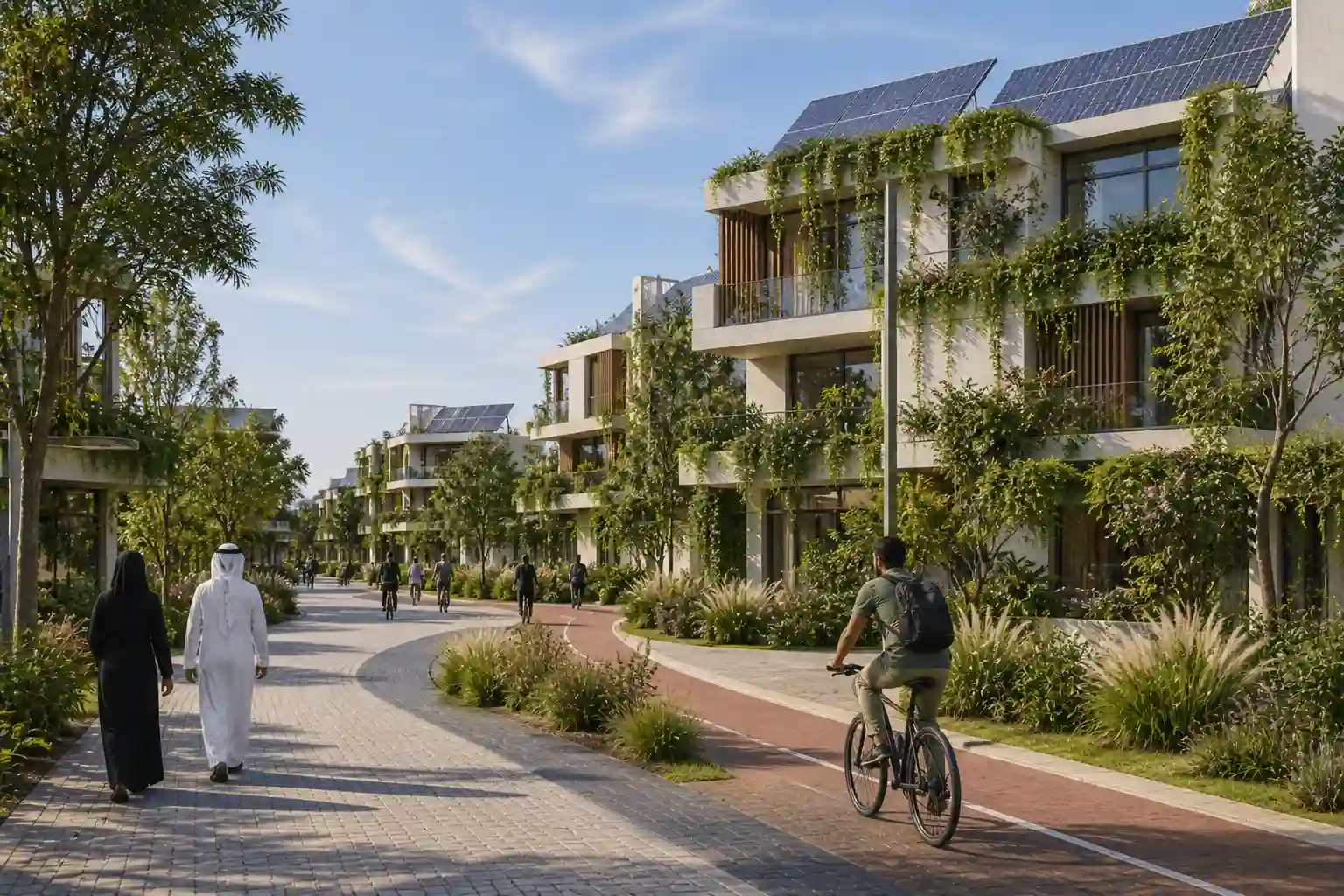
The Sustainable City incorporates pedestrian areas, cycling and jogging tracks, car-free residential clusters, and shared electric mobility options. Its current sustainability information also highlights electric buggies and EV charging infrastructure.
The equestrian club fits naturally into this model because it provides a recreation destination inside the community. Residents can access an outdoor activity without treating every leisure trip as a long-distance car journey.
For readers interested in the wider relationship between sustainability and urban development, see what makes a city sustainable.
3. The Club Encourages Environmental Awareness Through Horsemanship
The club’s activities extend beyond simply riding a horse. Its after-school and stable-management programs introduce participants to practical aspects of caring for horses.
The club lists activities such as grooming, tacking up, leading horses, feeding, stable cleaning, horse anatomy, and other stable-management topics as part of its educational programs.
For children in particular, this type of experience can provide direct exposure to animal care and outdoor environments. That does not automatically make every activity environmentally sustainable, but it does contribute to the community’s wider emphasis on interaction with nature and responsible recreation.
4. Green Spaces Are Central to the Community
The Sustainable City has been designed with substantial landscaped and recreational areas. Current community information highlights a central green spine, biodomes, community gardens, parks, playgrounds, cycling routes, jogging paths, and other green infrastructure.
The equestrian track becomes part of this larger landscape network. Instead of treating recreation as a separate enclosed facility, the development integrates different outdoor activities into the overall community environment.
This approach can make sustainability more visible in daily life because green infrastructure becomes something residents experience rather than simply read about.
5. Water Efficiency Supports the Eco-Friendly Model
Water conservation is especially important in the UAE because of the country’s hot and arid climate. The Sustainable City incorporates water-saving technologies as part of its environmental strategy.
The community states that it uses low-flow water fixtures, reduces water demand through smart irrigation, and treats wastewater for reuse in irrigation. Its broader sustainability framework also identifies water efficiency and greywater recycling as important parts of the development model.
These systems support landscaped areas without relying entirely on conventional potable-water consumption for irrigation.
For a broader look at household utilities and consumption considerations, readers can explore our guide to electricity and water costs in the UAE.
6. Solar Energy Is Integrated Into The Sustainable City
Renewable energy is another major part of the community’s environmental strategy. Rooftop solar panels are installed across the development, including on homes and parking structures.
The Sustainable City says its Dubai community uses solar panels alongside energy-efficient design and smart systems to reduce energy demand and support renewable power generation.
The equestrian club itself should not be presented as independently generating all of its energy through solar power unless the club specifically confirms that claim. The more accurate point is that the club operates within a community where renewable energy is a core part of the overall infrastructure.
Learn more about related technologies through our guides to solar panels, solar systems for homes, and solar energy in the UAE.
7. Waste Reduction Is Built Into the Community
Waste management is another important component of The Sustainable City’s sustainability model. The development promotes waste separation at source and reports a high landfill-diversion rate.
Its sustainability framework describes the use of the three Rs—reduce, reuse, and recycle—and identifies source sorting and recycling initiatives as part of the community’s waste strategy.
This is relevant to an equestrian environment because responsible management of materials and waste is particularly important in facilities involving animals, landscaping, maintenance, and outdoor activities.
For a wider UAE perspective, explore our guide to waste management companies in the UAE.
8. The Club Adds Social Sustainability
Sustainability has an environmental dimension, but The Sustainable City also places significant emphasis on social sustainability.
The community’s sustainability framework identifies social interaction, inclusion, wellbeing, education, sports, recreation, and community engagement as important elements of its model. Its facilities include sports areas, walking and cycling tracks, an animal sanctuary, educational facilities, and the equestrian centre.
The equestrian club contributes to this social dimension by creating a shared activity where children, adults, families, instructors, and riders can interact.
The club also works with Dubai primary schools for after-school activities, providing opportunities for children to learn riding and stable management.
9. Active Living Is Part of Sustainable Community Design
A sustainable neighbourhood should support healthy and active lifestyles rather than focusing exclusively on buildings and energy systems.
The Sustainable City incorporates cycling, jogging, sports facilities, swimming pools, gyms, pedestrian routes, and equestrian activities. Its current community framework explicitly includes sports and recreation as part of social sustainability.
The equestrian club therefore complements a broader active-lifestyle ecosystem. Horse riding provides a different type of physical activity from running, cycling, swimming, or conventional gym workouts.
For another perspective on active lifestyles in the UAE, explore our guide to the components of physical fitness.
10. The Equestrian Club Provides Family-Friendly Recreation
The club welcomes children from young ages and provides riding lessons, school activities, pony-related experiences, shows, and holiday programs. Its current website states that English-style riding lessons are available for adults and children aged three and above.
Family-oriented recreation is significant within a sustainable community because it allows residents to spend more leisure time within their neighbourhood rather than relying on long-distance travel for every activity.
This approach also complements other family-oriented facilities across The Sustainable City, including playgrounds, sports facilities, educational facilities, green spaces, and community amenities.
What Activities Are Available at Sustainable City Equestrian Club?
The club currently lists several activities and services:
- English-style riding lessons
- Track riding
- After-school riding activities
- Stable-management courses
- Carriage rides
- Horse shows
- Birthday and pony-related activities
- Holiday pony camps
The official club website also lists four outdoor riding schools and a four-kilometre hacking track around The Sustainable City.
Is Sustainable City Equestrian Club Only for Experienced Riders?
No. The club states that it offers instruction for beginners as well as more advanced riders. Its structured lesson system is designed to help participants progress through different levels of horsemanship.
This makes the facility relevant to families introducing children to horse riding as well as riders looking to develop existing skills.
Before visiting, however, check the club’s current schedule, package availability, requirements, and pricing directly because these details can change.
How the Equestrian Club Fits Into Sustainable City Living
The strongest connection between the equestrian club and eco-friendly living is not that horse riding itself eliminates environmental impact. Rather, the club is part of a community where recreation, mobility, landscaping, energy, water, waste, and social infrastructure are planned as interconnected systems.
| Sustainable City Feature | How It Supports the Community |
|---|---|
| Solar energy | Supports renewable electricity generation |
| Water recycling | Allows treated water to be reused for irrigation |
| Smart irrigation | Helps reduce landscape water demand |
| Green spaces | Supports outdoor recreation and community wellbeing |
| Car-free clusters | Encourage walking and reduce internal vehicle traffic |
| Electric mobility | Provides lower-emission transportation options |
| Waste separation | Supports recycling and landfill diversion |
| Equestrian facilities | Provide nature-based recreation and community activities |
Eco-Friendly Living Beyond The Sustainable City
The principles visible at The Sustainable City can also inspire homeowners elsewhere in Dubai and the UAE.
Residents can begin with practical measures such as improving energy efficiency, reducing water consumption, separating recyclable waste, using smart controls, choosing durable materials, and creating more efficient outdoor spaces.
Our guide to green living in the UAE covers broader ways residents can incorporate sustainability into everyday life.
Homeowners planning upgrades can also explore smart-home upgrades in the UAE and smart-home interior design ideas to combine comfort with more efficient use of energy and other resources.
For renovation projects, sustainable materials and efficient systems can also be incorporated from the planning stage. Our guide to home renovation in the UAE provides a broader framework for planning renovation work.
Sustainable Design and Modern UAE Homes
Sustainable living does not require abandoning contemporary design. UAE homeowners can combine efficient systems with attractive interiors, durable finishes, natural materials, smart controls, and thoughtful space planning.
For inspiration, see our guides to UAE interior design trends, modern Arabic home decor for UAE villas, and interior design styles in the UAE.
Homeowners can also consider sustainability when selecting furniture, lighting, appliances, flooring, paint, cabinetry, and landscaping. The objective is not simply to create a visually attractive home but to make choices that remain functional and durable over time.
Why the Sustainable City Model Is Interesting for Dubai
The Sustainable City provides an example of how environmental goals can be incorporated into the physical design of a residential community.
Instead of treating sustainability as one feature, the development combines energy efficiency, renewable energy, water management, waste systems, mobility, landscaping, recreation, education, and community facilities. The developer describes the Dubai project as its first operational sustainable development and a model intended to be scalable and replicable.
The equestrian club is one part of that wider system. Its value within the community comes from combining recreation and access to nature with a neighbourhood designed around sustainability principles.
Final Thoughts
The Sustainable City Equestrian Club Dubai demonstrates how recreation can become part of a broader sustainable-living environment. Its riding schools, four-kilometre track, stable-management activities, and family programs operate within a community that also incorporates solar energy, water reuse, smart irrigation, green spaces, electric mobility, waste separation, and car-free areas.
The club should therefore be viewed as one component of The Sustainable City’s wider environmental and social framework rather than as a standalone sustainability solution.
For Dubai residents interested in greener lifestyles, the broader lesson is practical: sustainability becomes more achievable when energy, water, transport, recreation, landscaping, waste, housing, and community life are designed to work together.