The UAE’s national sustainability framework includes the UAE Net Zero 2050 Strategy, the updated UAE Energy Strategy 2050, climate adaptation planning, sustainable development policies, and local urban strategies. The Net Zero 2050 Strategy covers six major sectors: power, industry, transport, buildings, waste, and agriculture.
At the city level, Dubai’s planning framework also addresses environmental quality, ecological corridors, parks, sustainable mobility, waste management, water management, energy efficiency, and district cooling.
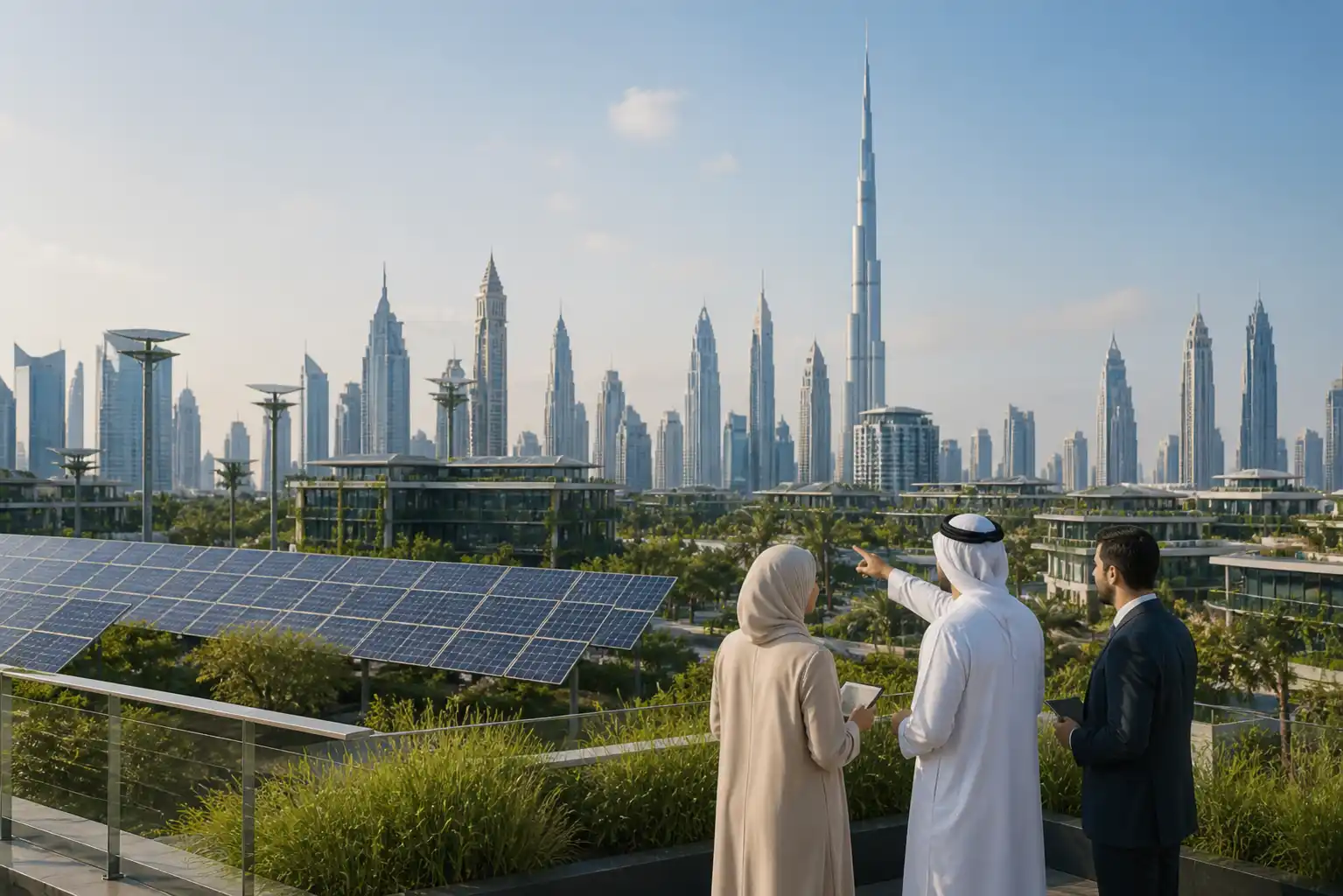
So what actually makes a UAE city sustainable and future-ready? The answer is a combination of environmental performance, resilient infrastructure, efficient resource use, smart technology, economic development, and liveable communities.
What Is a Sustainable City?
A sustainable city is an urban area designed to meet today’s needs while protecting resources and environmental quality for future generations. It considers environmental, social, and economic factors together rather than treating sustainability as a single project.
The UAE government’s definition of a smart sustainable city emphasises the use of information and communication technologies and other tools to improve quality of life, urban efficiency, and competitiveness while considering the needs of present and future generations.
This means a genuinely sustainable city needs to perform across several connected areas:
- Energy efficiency and clean energy
- Water conservation and efficient water systems
- Sustainable buildings and construction
- Low-emission and efficient transportation
- Waste reduction, recycling, and resource recovery
- Green spaces and biodiversity
- Climate resilience
- Smart infrastructure and data-driven services
- Efficient land-use planning
- Healthy and inclusive communities
For a broader explanation of the concept, see how Sustainable City Equestrian Club Dubai promotes eco-friendly living.
Why Environmental Sustainability Matters in the UAE
The UAE faces environmental conditions that make efficient resource management particularly important. High temperatures, limited natural freshwater resources, rapid urbanisation, energy demand, and pressure on ecosystems all influence how cities need to develop.
The UAE’s National Climate Change Plan identifies both emissions management and climate adaptation as important priorities. It also links climate action with economic diversification, innovation, infrastructure resilience, and quality of life.
This means sustainability is not simply an environmental issue. It affects housing, transport, infrastructure, business, energy security, water management, public spaces, and long-term urban resilience.
1. Clean and Efficient Energy Systems
Energy is one of the most important components of sustainable urban development. Cities require electricity for buildings, cooling, lighting, transport infrastructure, water systems, businesses, and public services.
The UAE Energy Strategy 2050 aims to increase renewable energy deployment, improve energy efficiency, support clean-energy technologies, and expand clean-energy capacity. The strategy’s first-phase targets include tripling the contribution of renewable energy by 2030 and improving individual and institutional energy-consumption efficiency by 42–45% compared with 2019.
For cities, this translates into practical priorities such as:
- Solar power generation
- Energy-efficient buildings
- Efficient air-conditioning systems
- Smart energy management
- Efficient district cooling
- Energy-efficient lighting
- Electric mobility infrastructure
- Energy monitoring and optimisation
Explore related UAE energy topics through our guides to solar energy in the UAE, solar panels, and renewable energy in the UAE.
2. Sustainable Buildings and Construction
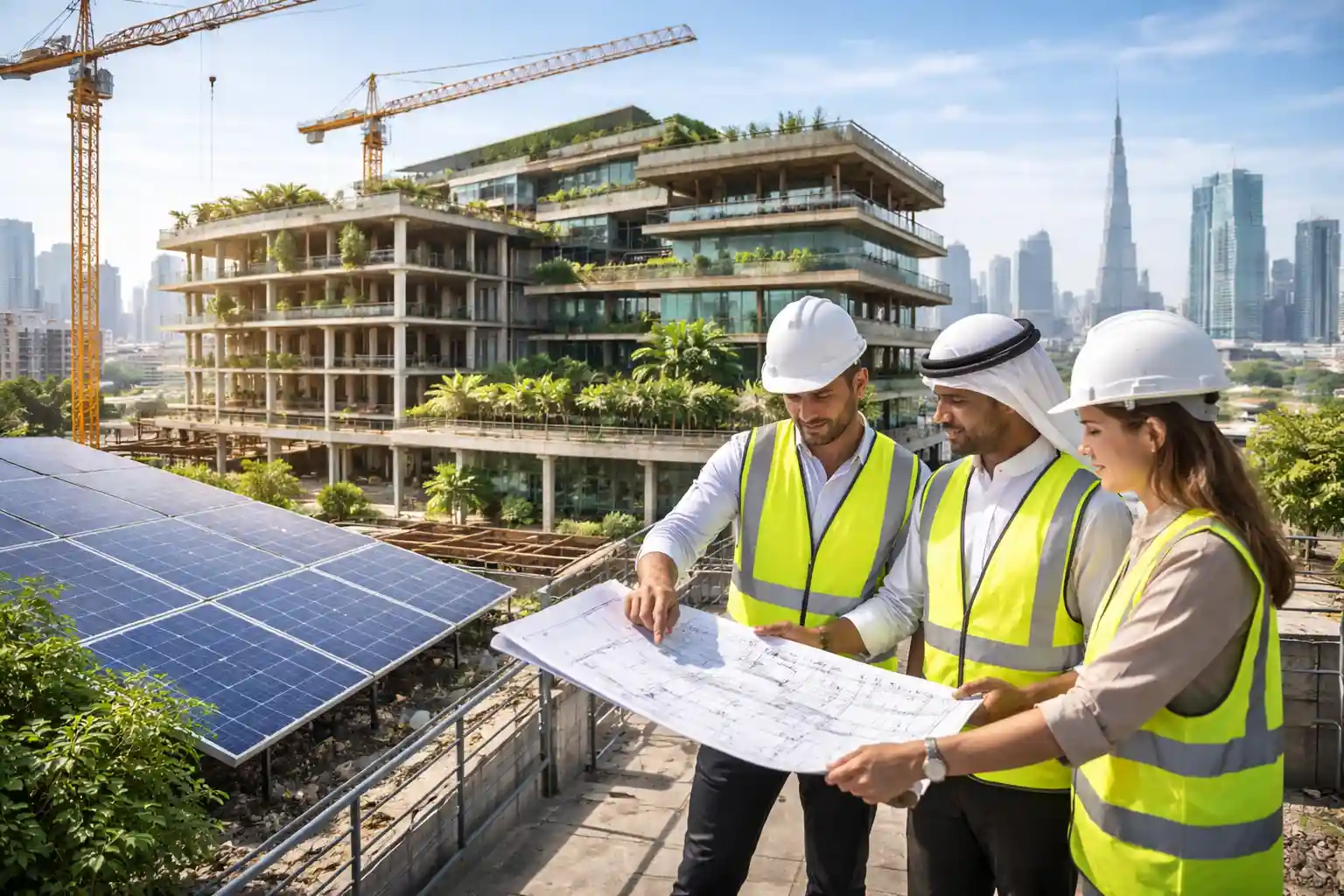
Buildings have a major influence on urban energy demand, indoor comfort, resource consumption, and environmental performance. In the UAE, sustainable building design can address issues such as solar heat gain, insulation, glazing, cooling efficiency, lighting, water consumption, and material selection.
Sustainable construction also considers the environmental impact of materials, construction processes, demolition waste, building maintenance, and the eventual reuse or recycling of components.
The UAE’s Net Zero 2050 Strategy specifically includes buildings among its six major sectors and identifies green building practices and efficiency improvements as part of the transition.
For more information, read about sustainable construction trends in the UAE and UAE construction industry trends and opportunities.
3. Water Conservation and Water Security
Water is particularly important in the UAE because of its naturally limited freshwater resources. Sustainable cities therefore need to reduce unnecessary consumption while maintaining reliable water services.
Urban water sustainability can include:
- Efficient fixtures
- Smart irrigation
- Wastewater treatment and reuse
- Leak detection
- Efficient landscaping
- Water-demand monitoring
- Appropriate plant selection
- Efficient cooling and industrial water systems
The UAE’s wider policy framework includes the UAE Water Security Strategy 2036, reflecting the importance of water availability and resource management in long-term national planning. The government also identifies sustainable water management as an important element of smart and sustainable urban development.
Residents can explore practical household considerations through our guide to electricity and water costs in the UAE.
4. Sustainable Transportation and Mobility
A sustainable city needs transportation systems that move people and goods efficiently while reducing unnecessary environmental impacts.
Dubai’s 2040 urban planning framework specifically calls for sustainable travel behaviour, integrated land use and transport, future-proof mobility systems, active-mobility-friendly streets, and sustainable freight management.
In practical terms, sustainable urban mobility can involve:
- Public transportation
- Metro and rail systems
- Electric vehicles
- EV charging infrastructure
- Walking infrastructure
- Cycling networks
- Transit-oriented development
- Efficient freight systems
- Integrated transport planning
The goal is not simply to replace petrol cars with electric cars. Sustainable mobility also means creating neighbourhoods where people can reach everyday services efficiently and safely.
5. Green Spaces, Biodiversity, and Urban Nature
Green infrastructure is another essential component of a sustainable city. Parks, tree-lined streets, ecological corridors, wetlands, landscaped areas, and natural habitats can contribute to urban environmental quality and quality of life.
Dubai’s 2040 urban planning framework includes improving environmental quality, protecting natural conservation areas, developing ecological corridors, providing parks and recreation systems, and preserving and enhancing waterfronts and waterways.
Urban greenery can also provide shade, support biodiversity, improve the experience of public spaces, and help create more comfortable pedestrian environments.
However, landscaping in the UAE must be designed with water efficiency in mind. A sustainable landscape is not necessarily the one with the most greenery; it is one designed to use resources appropriately for its climate and purpose.
6. Waste Reduction and Circular Resource Management
A sustainable city must consider what happens to materials after they are consumed. Simply collecting waste is not enough. Cities can reduce environmental impacts through prevention, reuse, recycling, recovery, and more efficient resource management.
The UAE Net Zero 2050 Strategy includes waste as one of its six major sectors.
Urban waste strategies can include:
- Source separation
- Recycling infrastructure
- Organic waste management
- Construction and demolition waste recovery
- Reuse of materials
- Responsible disposal
- Waste-to-resource systems
- Public awareness campaigns
See our guide to waste management companies in the UAE for more information about this sector.
7. Smart Technology and Data-Driven Cities
Future-ready cities increasingly rely on sensors, connectivity, automation, data platforms, and digital services to improve the efficiency of urban systems.
The UAE government describes smart sustainable cities as places where technology can improve quality of life, operational efficiency, and competitiveness while supporting environmental, social, and economic objectives.
Smart-city applications can include:
- Smart electricity meters
- Intelligent traffic management
- Smart parking
- Building-management systems
- Air-quality monitoring
- Water monitoring
- Smart waste systems
- Connected public services
- Digital government services
- Predictive infrastructure maintenance
The important point is that technology should solve a real urban problem. Installing connected devices without improving efficiency, resilience, or service quality does not automatically make a city sustainable.
8. Climate Resilience and Future-Proof Infrastructure
A sustainable city must prepare for environmental conditions that may become more challenging over time.
The UAE’s National Climate Change Plan emphasises climate adaptation and the need to protect infrastructure, people, ecosystems, and the economy from climate-related impacts.
Future-ready infrastructure can therefore include:
- Heat-resilient buildings
- Efficient cooling systems
- Stormwater management
- Flood-risk planning
- Resilient electricity networks
- Reliable water infrastructure
- Climate-conscious landscaping
- Emergency-response systems
- Protection of ecological areas
Dubai’s 2040 framework specifically identifies stormwater and floodplain management, environmental quality, ecological corridors, and resilient infrastructure considerations within its urban planning objectives.
9. Sustainable Urban Planning and Land Use
City sustainability begins before buildings are constructed. The location of housing, workplaces, schools, retail areas, parks, transport stations, and community facilities influences how people move and how infrastructure is used.
Compact and connected development can reduce unnecessary travel distances, while mixed-use areas can place services closer to residents.
Dubai’s 2040 framework links land use and transport and promotes centres-focused, transit-oriented development.
This demonstrates why sustainable urban planning is broader than environmental landscaping. It involves deciding where different activities should happen and how they connect.
10. Sustainable Cooling in the UAE
Cooling deserves special attention in UAE cities because of the country’s climate and the importance of indoor thermal comfort.
Efficient cooling can involve better building envelopes, insulation, efficient equipment, smart controls, appropriate temperature management, and district cooling systems where suitable.
Dubai’s 2040 urban planning framework specifically identifies sustainable, energy-efficient management systems and a cost-effective sustainable district-cooling strategy among its utilities objectives.
For individual homeowners, cooling efficiency can also be considered alongside smart-home systems and renovation decisions. Explore our guide to smart-home upgrades in the UAE for related ideas.
11. Sustainable Food and Urban Agriculture
Food systems are another part of urban sustainability. Cities can reduce some environmental pressures by supporting efficient food production, local growing initiatives, responsible supply chains, and better management of food waste.
Dubai’s 2040 framework includes increasing food security through urban agriculture and food production as one of its environmental and open-space objectives.
In the UAE, this can connect sustainability with technologies such as controlled-environment agriculture, greenhouses, efficient irrigation, and data-driven farming.
12. Economic Sustainability and Green Jobs
A city cannot be considered future-ready if its environmental strategy is disconnected from economic development. Sustainable infrastructure requires investment, skilled workers, innovation, technology providers, construction companies, engineers, researchers, and service businesses.
The UAE Net Zero 2050 Strategy identifies economic and societal advancement as part of the transition and projects employment and economic opportunities in sectors including solar, batteries, and hydrogen.
This creates opportunities across clean energy, sustainable construction, environmental services, mobility, water technology, waste management, engineering, data systems, and other emerging sectors.
13. Social Sustainability and Quality of Life
Environmental performance is only one part of a successful city. Residents also need safe public spaces, recreation, healthcare, education, mobility, employment opportunities, accessible services, and a strong sense of community.
The UAE government’s smart sustainable city framework explicitly connects sustainability with quality of life, efficiency, competitiveness, and the needs of future generations.
This is why parks, pedestrian routes, public transport, community facilities, sports infrastructure, and digital services can be considered sustainability infrastructure as well as lifestyle amenities.
Examples of Sustainable Urban Development in the UAE
The UAE has developed several projects and strategies that illustrate different approaches to sustainable urban development.
The Sustainable City, Dubai
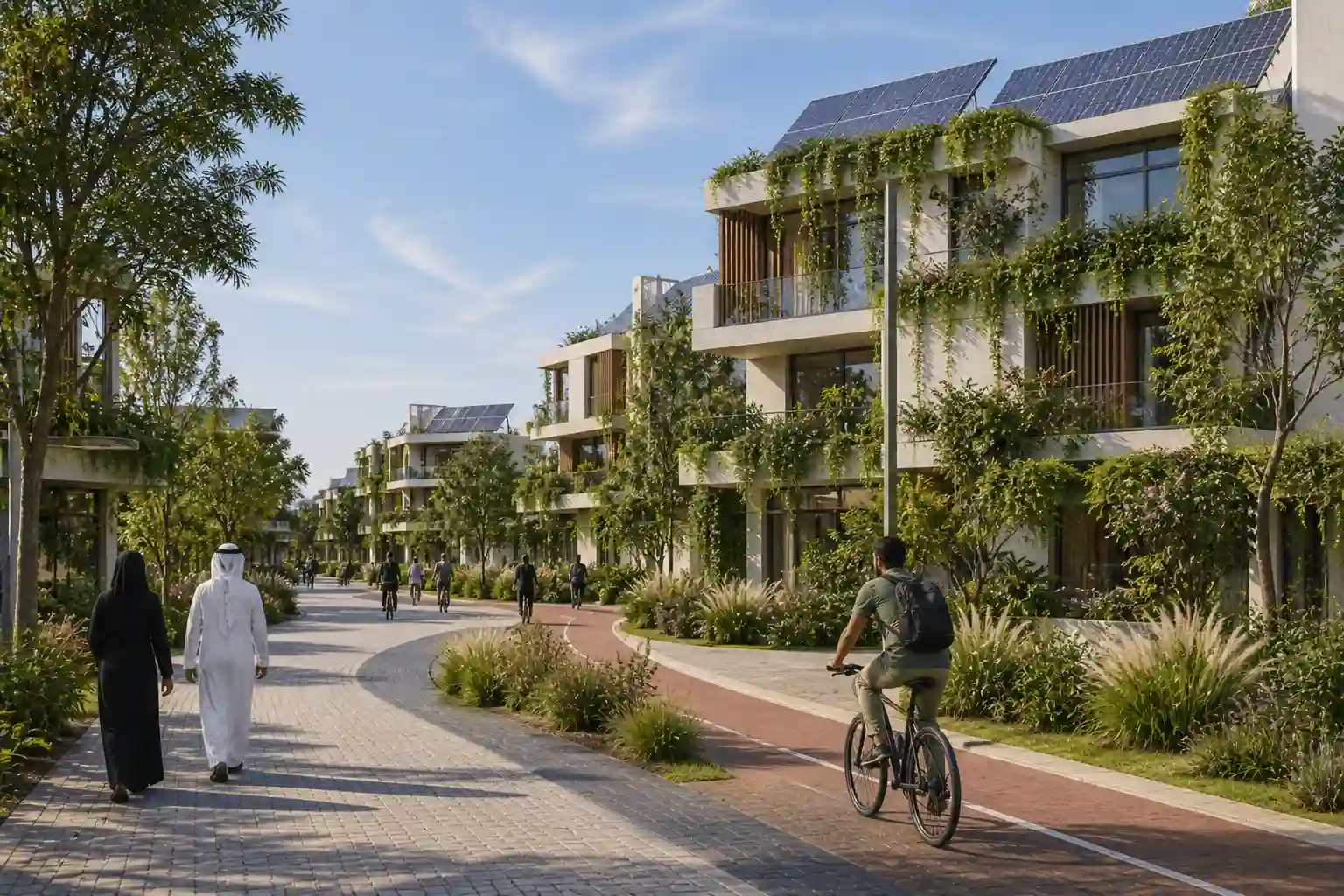
The Sustainable City in Dubai is a prominent example of community-scale sustainable development. The UAE government identifies it among Dubai’s smart sustainable-city projects and notes features including solar energy, energy-saving appliances, a car-free environment, extensive trees, and organic farms.
Read our dedicated article on Sustainable City Equestrian Club Dubai and eco-friendly living.
Sharjah Sustainable City
The UAE government also identifies Sharjah Sustainable City as an integrated sustainable community designed around energy and environmental objectives.
These projects demonstrate that sustainability can be incorporated at the neighbourhood scale rather than being limited to individual buildings.
How UAE Residents Can Support Sustainable Cities
Urban sustainability is not solely the responsibility of governments and developers. Residents, businesses, landlords, and property owners also influence resource consumption and waste generation.
At Home
- Use energy-efficient lighting and appliances.
- Manage air-conditioning efficiently.
- Reduce unnecessary water consumption.
- Use smart controls where they provide genuine efficiency benefits.
- Separate recyclable materials where collection systems are available.
- Choose durable products rather than disposable alternatives.
- Consider solar energy where technically and financially appropriate.
When Renovating
Home renovations provide an opportunity to improve environmental performance. Efficient lighting, better insulation, water-saving fixtures, durable materials, smart controls, and efficient appliances can all be considered as part of the renovation brief.
See our guide to home renovation costs and ideas in the UAE for broader project-planning considerations.
Interior design can also support sustainability when material durability, efficient lighting, responsible sourcing, and long-term usability are considered alongside aesthetics. Explore UAE interior design trends for current design context.
How Businesses Can Contribute to Sustainable Cities
Businesses influence energy use, transportation, construction, packaging, waste, supply chains, and commercial buildings. Their decisions can therefore have a significant cumulative effect on urban sustainability.
Businesses can consider:
- Energy-efficient offices and facilities
- Renewable energy procurement
- Waste reduction and recycling
- Efficient logistics
- Digital processes that reduce unnecessary paper use
- Water-efficient operations
- Sustainable procurement
- Employee mobility programs
- Green building standards
- Environmental performance measurement
The UAE’s climate policy framework recognises the private sector’s role in environmental goods, services, innovation, and economic diversification.
For businesses interested in sustainability-related development, explore our guide to sustainability initiatives in the UAE.
What Makes a UAE City Truly Future-Ready?
A future-ready city should not rely on a single technology or sustainability feature. Its systems should work together and remain adaptable as population, climate conditions, technology, and economic requirements change.
| Area | Future-Ready Approach |
|---|---|
| Energy | Renewable energy, efficiency, smart management and resilient grids |
| Water | Efficient consumption, reuse, monitoring and long-term water security |
| Buildings | Efficient design, sustainable materials and climate resilience |
| Transport | Public transport, active mobility, EVs and integrated planning |
| Waste | Reduction, reuse, recycling and resource recovery |
| Nature | Green spaces, biodiversity protection and ecological corridors |
| Technology | Connected systems, data and smart urban services |
| Climate | Resilient infrastructure and adaptation planning |
| Economy | Green industries, innovation, investment and skilled employment |
| Community | Accessible services, healthy environments and quality of life |
Environmental Sustainability in UAE: The Bigger Picture
The UAE’s sustainability journey is increasingly moving from individual environmental projects toward integrated systems. National strategies address energy, emissions, buildings, transport, waste, agriculture, climate adaptation, and water security, while local urban plans translate these objectives into land-use, infrastructure, mobility, and community development.
The UAE Government’s Net Zero 2050 Charter, updated in 2026, also brings federal and local governments together around climate action, including cooperation on transport, construction, industry, biodiversity, environmental protection, and public awareness.
This integrated approach is important because urban sustainability problems are interconnected. Energy-efficient buildings can reduce electricity demand; better public transport can reduce dependence on private vehicles; water reuse can support landscaping; green infrastructure can improve urban environments; and smart technology can help monitor and optimise all of these systems.
Final Thoughts
Environmental sustainability in the UAE is about creating cities that use resources efficiently, respond to climate risks, support economic development, protect natural systems, and provide a high quality of life.
A sustainable and future-ready UAE city therefore needs more than solar panels or green buildings. It needs coordinated energy, water, transport, waste, construction, mobility, technology, biodiversity, and community strategies.
Dubai’s 2040 planning framework and the UAE’s national Net Zero and energy strategies show how these different areas are increasingly being considered together.
For residents and businesses, the practical lesson is equally important: sustainability can be incorporated into everyday decisions—from energy and water consumption to transportation, construction, renovation, waste management, and the design of homes and workplaces.